
Why IT Recruitment Is Harder in the AI Hiring Shift?
Author:
Date: 09-04-2026
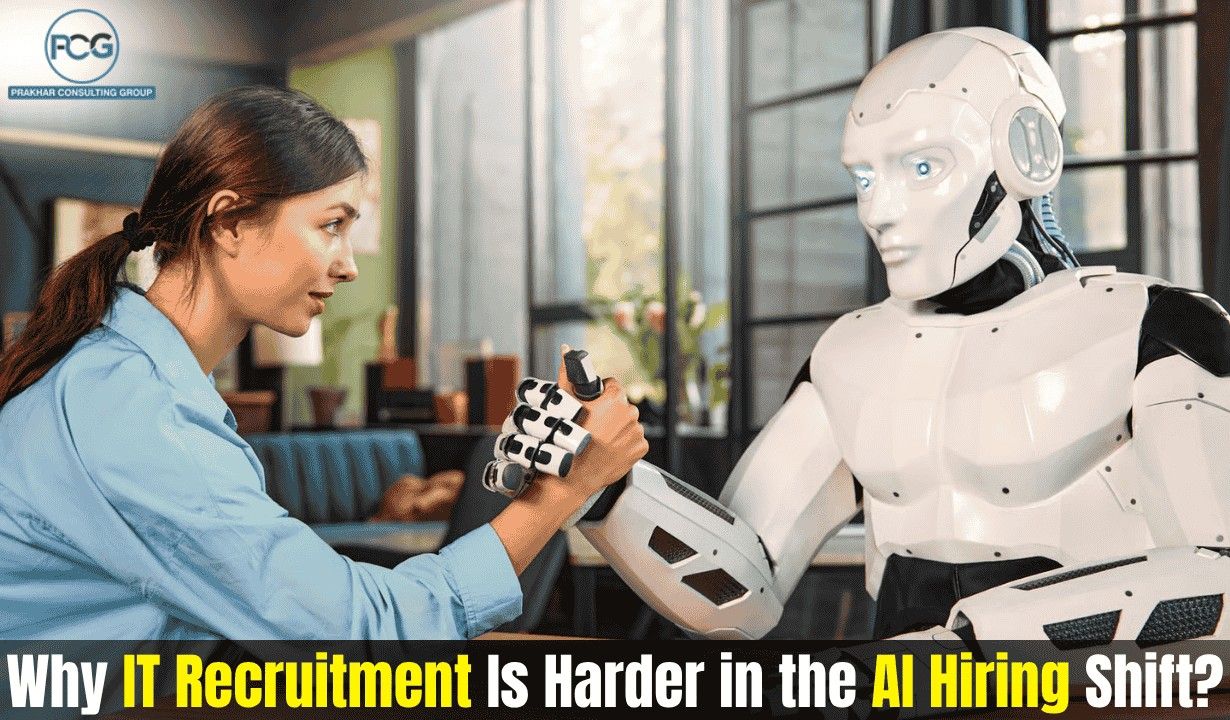
IT recruitment is harder because AI has changed skill demand, hiring design, compliance exposure, and candidate behaviour faster than most firms can adapt.
Indian founders and HR leaders are facing a hiring paradox. Roles are open, budgets are approved, yet closures are slow. Teams report talent shortage, but candidates say roles are unclear. The shift is not about fewer candidates. It is about the mismatch between expectation and capability.
IT Recruitment Services in India now demand skills intelligence, faster decision cycles, and compliance alignment rather than just sourcing volume.
In fact, hiring today requires evaluating present skill, future adaptability, and compliance risk together. That is why traditional hiring models are breaking.
Why is IT Recruitment Harder Now?
The reason is that AI has changed hiring criteria faster than hiring systems have evolved. Organizations like LinkedIn Talent Solutions and NASSCOM highlight a clear shift toward skills-first hiring. Degrees and titles are no longer enough.
A 2026 trend analysis shows that companies now need hybrid professionals. These professionals combine coding, AI understanding, business thinking, and communication skills.
- Skills-based hiring is replacing role-based hiring.
- AI-related roles are growing, but skill fit is narrow.
- Demand is high, but correct-fit supply is limited.
In 2026, mid-sized Indian firms face 20%-30% delays in closing niche IT roles due to skill mismatch and evaluation gaps.
According to HR policy advisors at NASSCOM, “The challenge is no longer access to talent, but accuracy in identifying usable skills.”
What is Breaking Hiring Systems Today?
Most companies overlook that outdated hiring frameworks cannot evaluate modern AI-driven roles. Traditional job descriptions still focus on static roles. However, AI roles require dynamic capability mapping.
Where does the funnel fail?
Hiring funnels are not designed for evolving roles. Therefore, screening rejects capable candidates while selecting mismatched ones.
- Hiring funnel stages: role clarity, sourcing, screening, evaluation, and offer.
- Attrition risk rises when role expectations are unclear.
- Workforce planning often lacks future skill mapping.
Here’s what the numbers reveal: In 2026, early-stage offer drop-offs range between 15%-25% for niche tech roles when hiring decisions are delayed or unclear.
A senior advisor at SHRM India explains, “Companies are adopting AI tools, but hiring processes are still human-lagged.”
How Should IT Companies Solve This Hiring Challenge?
The solution is to redesign hiring as a skills-first, business-aligned system. This is where a Top Leadership Hiring Consultancy like Prakhar Consulting Group (PCG) becomes critical. The focus shifts from filling roles to building capability.
Practical fixes for 2026 hiring
- Redefine roles based on outcomes, not job titles.
- Build skill-based assessments instead of resume filtering.
- Align hiring speed with business urgency.
- Integrate compliance checks at the offer stage.
In 2026, companies using structured hiring frameworks report up to 25% faster closures and lower early attrition.
According to workforce planners at NASSCOM, “Future-ready hiring depends on mapping capability, not just filling vacancies.”
What Does the Future of IT Recruitment Look Like?
Future hiring will be driven by skills intelligence, automation, and workforce planning integration. Companies that adapt will treat hiring as a strategic function, not an operational task.
To Solve Long-Term Hiring Issues, Prakhar Consulting Group (PCG) helps organizations build structured hiring ecosystems. This includes workforce forecasting, hiring SLAs, and post-joining performance tracking.
Future-ready hiring model
- 3-layer workforce plan: immediate, quarterly, annual
- Integrated hiring dashboards with business metrics
- Continuous skill gap analysis
Here’s what the numbers reveal: Firms that align hiring with business planning see up to 30% improvement in team productivity within one year.
A senior HR strategist at SHRM India notes, “Hiring success will depend on how closely HR aligns with business outcomes.”
Conclusion
IT recruitment is harder today because hiring expectations have evolved faster than hiring systems. Skills are changing, compliance is tighter, and candidate behaviour is smarter. However, the solution is clear. Companies must shift from reactive hiring to structured, strategic hiring systems. For founders and HR leaders, this is not just a hiring problem. It is a business growth challenge. The right hiring partner, such as Prakhar Consulting Group, can help transform hiring into a long-term competitive advantage.
FAQs
Q. What is the AI hiring shift in IT recruitment?
It is the move from role-based hiring to skills-based and capability-driven hiring.
Q. Why are IT roles harder to fill now?
Because companies need hybrid skills and better evaluation methods.
Q. How does compliance impact IT hiring?
It affects compensation, employment type, and onboarding processes.
Q. Why do candidates drop out before joining?
Due to slow hiring, unclear roles, and better competing offers.
Q. What is the best way to improve IT hiring?
Adopt skills-first hiring, align with business goals, and improve hiring speed.